Mega menu

tetasidjaslkihsdlkjfhsdf gjkhsdfgjklsdhfgjkl shdfgjklhsdfgjkl hsdfjklg hsdfkjlg hsdfjklg hsdfjkl ghsdfjkl ghsdfjklgh
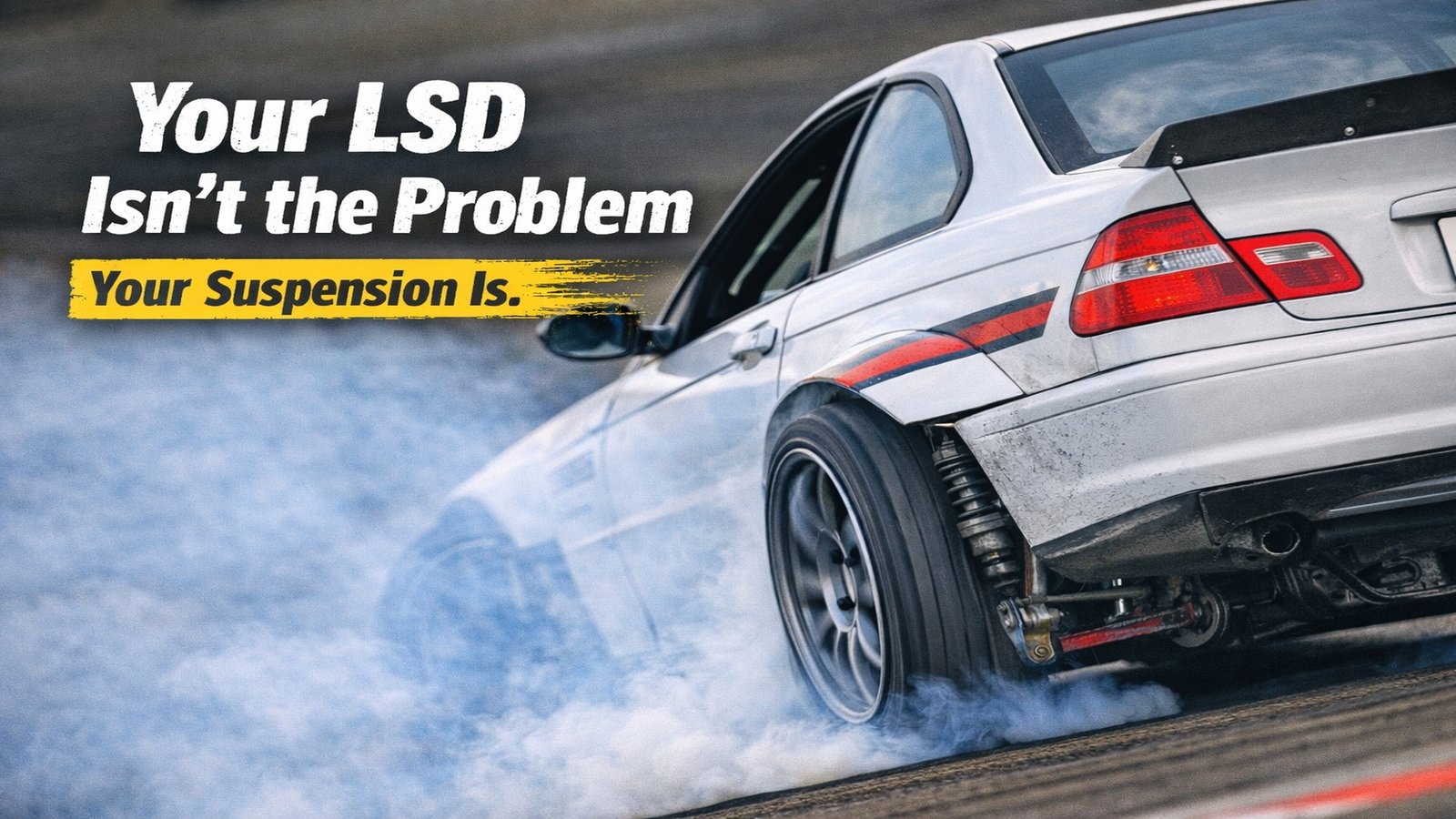

When drivers experience inconsistent traction, unpredictable locking, or strange differential behavior, the first instinct is often to blame the differential itself.
But in many cases, the real problem is not inside the diff at all.
Your suspension setup has a huge influence on how a limited slip differential (LSD) works. An LSD can only distribute torque based on the grip available at each driven wheel. If the suspension creates unstable, inconsistent, or extreme grip differences between the left and right wheels, even the best differential will struggle to perform properly.
Your LSD is only as good as your suspension setup.

Your LSD isn’t the problem. Your suspension is.
One of the most common problems with low-budget coilovers is limited shock travel. The car may look aggressive when lowered, but if suspension travel is too short, the wheel can easily lose contact with the road over bumps or during sharp cornering.
On a rear-wheel-drive car, that creates a big problem for the differential. Instead of working with two tires that have a relatively stable contact patch, the LSD suddenly has to deal with one wheel that has strong grip and another that is partially unloaded or even lifted.
This often results in:

Limited suspension travel can cause inside wheel lift and unstable LSD behavior.
Excessively soft springs or low compression damping can create too much body roll on the driven axle. While this may feel comfortable at lower speeds, it is not ideal for traction consistency.
As the body rolls more, the load difference between the left and right driving wheels becomes more extreme. That means the LSD is constantly reacting to uneven conditions instead of operating in a smooth and predictable way.
Typical symptoms include:

Excessive body roll creates unstable grip differences between the rear wheels.
A rear anti-roll bar plays a major role in controlling side-to-side load transfer on the rear axle. This is especially important in drifting, where the car is exposed to fast transitions and aggressive weight shifts.
If the rear anti-roll bar is too soft, or completely absent, the rear axle can experience very large grip differences between the left and right wheels during transitions. In that situation, the diff is not working with a balanced rear end. Instead, it is constantly trying to compensate for rapid load swings from one side to the other.
In drift applications, this often shows up as:
Practical tip: If you are running 2-way adjustable coilovers, it is often better to reduce front rebound rather than soften rear compression too much. That approach can help the car rotate without creating unnecessary instability for the rear axle and the differential.

A proper rear anti-roll bar helps maintain more consistent rear wheel loading during transitions.
Very low ride height is popular for visual reasons, but in many cases it makes the car perform worse rather than better. If the car is lowered too much without correcting the suspension geometry, the result is often a poor roll center, worse control arm angles, and unnecessary stress on CV joints and driveline components.
This does not help the differential. In fact, it makes the job of the differential harder because tire contact becomes less stable and the rear suspension works in a less effective range.
Without proper roll center correction, flooring the car often leads to:

Lower is not always better. Bad geometry can hurt both handling and differential performance.
Large brake kits are often chosen for appearance, but unnecessarily large brake discs can add both unsprung mass and rotational mass. That has a direct effect on the way the drivetrain feels and responds.
The heavier the rotating parts are, the more load the differential sees during acceleration and deceleration. This does not mean big brakes are always bad, but oversized brake setups with no real performance need can create more stress than benefit.
Additional unsprung and rotational mass can lead to:

Oversized brakes add weight that the suspension and drivetrain must constantly control.
Rear suspension that is too stiff for the surface can make the car feel nervous, especially on public roads or bumpy race tracks. A common issue is excessive rear rebound damping or overly stiff rear springs.
When the car hits a bump, apex curb, or rough patch of road, the rear wheel may not return to the ground smoothly. Instead, traction comes back abruptly. Under throttle, this can create an impulsive on-off feeling, almost like a pulsed signal rather than smooth torque delivery.
This is especially hard on the differential because it creates repeated shock loads through the drivetrain.
Possible consequences include:

Wheel bounce and abrupt grip return create shock loads through the differential.
Your suspension might be excellent, but the tire contact patch still defines the final grip available to the differential. The LSD can only distribute the traction that the tires actually provide.
Uneven rear tire pressures, mismatched tire compounds, or poor tire selection can exaggerate grip differences between the left and right wheels. When that happens, the differential has to work with an unstable foundation.
This can lead to:

The contact patch is where differential performance becomes real traction.
Soft, worn, or damaged bushings allow unwanted suspension and subframe movement under load. That movement changes geometry dynamically and makes the rear axle less precise.
As a result, the LSD may feel delayed, inconsistent, or disconnected from what the driver expects. The issue is not always the diff itself, but the moving platform around it.
Common effects include:

Worn bushings and subframe movement reduce rear axle precision and make the differential feel inconsistent.
A flexible chassis absorbs load instead of transferring it efficiently through the suspension and tires. That reduces the effectiveness of both the suspension setup and the LSD.
Even a very good differential cannot work at its full potential if the chassis itself is moving too much. When the shell twists, the suspension cannot control the tire contact patch as accurately as it should.
This can lead to:
In drifting, an LSD is constantly exposed to aggressive throttle inputs, fast transitions, and large weight transfers. That means suspension setup becomes even more important. A well-built differential cannot fully compensate for poor wheel control, bad geometry, or sudden grip changes caused by the wrong suspension setup.
The same idea applies on the street and on track days. If the rear wheels are not loaded consistently, the differential cannot deliver consistent performance.
That is why the best results never come from focusing on one component only. The differential and suspension need to work together as one system.
A limited slip differential is not a magic fix for poor chassis behavior. It is a mechanical tool that works best when the suspension allows both driven wheels to maintain stable and predictable grip.
If the suspension setup creates:
then the LSD will be forced to work harder, perform worse, and wear faster.
Before blaming the differential, it is worth asking whether the suspension is helping it or fighting it.
That is the real foundation of traction, consistency, and drivetrain longevity.
At RacingDiffs, driveline components are tested in real driving conditions because differential performance never depends on one part alone. The best results always come from a balanced setup where the suspension, tires, and differential work together.